

The best time to visit Chicago for most first-time sightseeing trips is September. May is the best alternative. At Chicago O’Hare, September’s normal high is 75.5°F (24.2°C) and its low is 57.1°F (13.9°C), per the National Weather Service 1991–2020 normals. That suits walking, architecture, and neighborhood days.
The trade-off is swimming: Chicago’s beach season ends on Labor Day. Neither month guarantees low prices or small crowds, and beaches, festivals, or a winter city break call for a different month.
Best Time to Visit Chicago by Priority
| Priority | Time to consider | Main trade-off |
|---|---|---|
| First-time sightseeing and walking | September; May as the alternative; October for cooler air | No swimming after Labor Day. May is the wettest month in the NWS normals. |
| Swimming and beaches | June to August. The beach season runs from the Friday before Memorial Day through Labor Day. | Hottest months. Lonely Planet calls summer peak season with top hotel rates. |
| Festivals and events | Pick the event first: St. Patrick’s (March), Lollapalooza (late July to early August), the marathon (October), the holiday market (late November to December) | Closures, reroutes, busy transit. Dates change yearly. |
| Indoor attractions and winter | January and February; late November and December for holiday events | Cold and snow |
| Budget | Winter, especially January and February, per Choose Chicago. May and September to October, per Lonely Planet. | General tendencies, not measured rates. Events can push prices up. |
Weather figures are NWS data. Price and crowd notes are travel-source tendencies.
Chicago Weather by Month
Planning the best time to visit Chicago starts with the numbers. The table uses NWS monthly normals for Chicago, IL, 1991–2020, which the NWS identifies as Chicago O’Hare, the city’s official climate site since 1980.
| Month | Avg high °F / °C | Avg low °F / °C | Precipitation (in) | Snowfall (in) | Planning implication |
|---|---|---|---|---|---|
| January | 31.6 / −0.2 | 18.8 / −7.3 | 1.99 | 11.3 | Build an indoor-led trip |
| February | 35.7 / 2.1 | 21.8 / −5.7 | 1.97 | 10.7 | Keep outdoor stops short |
| March | 47.0 / 8.3 | 31.0 / −0.6 | 2.45 | 5.5 | Pack for lingering winter |
| April | 59.0 / 15.0 | 40.3 / 4.6 | 3.75 | 1.3 | Pair walks with indoor backups |
| May | 70.5 / 21.4 | 50.6 / 10.3 | 4.49 | Trace | Walkable, keep a rain plan |
| June | 80.4 / 26.9 | 60.8 / 16.0 | 4.10 | 0.0 | Warm, but not always dry |
| July | 84.5 / 29.2 | 66.4 / 19.1 | 3.71 | 0.0 | Avoid long midday walks |
| August | 82.5 / 28.1 | 65.1 / 18.4 | 4.25 | 0.0 | Mix lakefront and indoor plans |
| September | 75.5 / 24.2 | 57.1 / 13.9 | 3.19 | 0.0 | Strong all-round balance |
| October | 62.7 / 17.1 | 45.4 / 7.4 | 3.43 | 0.2 | Bring layers |
| November | 48.4 / 9.1 | 34.1 / 1.2 | 2.42 | 1.8 | Anchor days indoors |
| December | 36.6 / 2.6 | 24.4 / −4.2 | 2.11 | 7.6 | Plan warm breaks |
Highs and lows are average daily extremes. Precipitation is monthly rain plus melted snow, in inches, not a count of rainy days. Snowfall is the month’s accumulation, not depth on the ground, and “Trace” is measurable but tiny. A normal is a 30-year average, not a forecast, and an airport can’t describe every lakefront spot, so check the forecast before packing.
Best Season to Visit Chicago
Spring is a mix: March still feels like winter, while May is far better for walking. Choose Chicago highlights spring flowers.
Summer is the best time to visit Chicago for beaches, outdoor dining, and a full events calendar, at the cost of hot days, wet spells, and higher prices.
Fall is best early, for sightseeing on foot. September stays warm and October is cooler. Choose Chicago points to foliage and Halloween activities. By November, plan around museums.
Winter suits museums, theater, dining, and holiday trips. Lonely Planet notes lower tourist numbers and hotel deals. Cold, wind, and snow make outdoor plans hardest.
Chicago Month by Month
January in Chicago
- Typical conditions: The coldest month: high 31.6°F (−0.2°C), low 18.8°F (−7.3°C), 11.3 inches of snow. In an average January, 16.5 days stay at or below 32°F (0°C).
- Why visit: Museums, restaurants, theater. Chicago Restaurant Week is a winter tradition, so check the dates.
- Crowds and cost: Lonely Planet reports lower tourist numbers and hotel deals in winter.
- Watch out for: Wind chill. Check the NWS wind chill chart.
- Best for: An indoor city break.
February in Chicago
- Typical conditions: High 35.7°F (2.1°C), low 21.8°F (−5.7°C), 10.7 inches of snow, per the NWS normals.
- Why visit: Chicago Theatre Week offers value-priced tickets. Check the current dates.
- Crowds and cost: Price Valentine’s weekend separately.
- Watch out for: A touch milder than January, but still tough for outdoor-heavy plans.
- Best for: Theater fans.
March in Chicago
- Typical conditions: High 47.0°F (8.3°C), low 31.0°F (−0.6°C), 5.5 inches of snow (NWS). Don’t count on spring warmth.
- Why visit: St. Patrick’s. In 2026 the CTA listed the parade and river dyeing for March 14. 2027 dates weren’t confirmed when checked.
- Crowds and cost: The CTA says street closures may occur near Grant Park and some buses may be rerouted.
- Watch out for: Standing at a parade needs a warmer plan than museum hopping.
- Best for: Event-focused travelers who can handle leftover winter.
April in Chicago
- Typical conditions: High 59.0°F (15.0°C), low 40.3°F (4.6°C), 3.75 inches of precipitation (NWS).
- Why visit: Park walks on good days, museums on bad ones, and spring flowers (timing varies).
- Crowds and cost: Nothing we found shows April is consistently cheap or quiet.
- Watch out for: Lonely Planet warns of sun, snow, or rain in one day.
- Best for: Flexible sightseers without beach plans.
May in Chicago
- Typical conditions: High 70.5°F (21.4°C), low 50.6°F (10.3°C). The wettest month in the normals, with 4.49 inches (NWS).
- Why visit: Parks, lakefront trails, neighborhood walks.
- Crowds and cost: Lonely Planet places May in the shoulder season, with possible deals. Big events can still raise prices.
- Watch out for: Swimming season starts the Friday before Memorial Day.
- Best for: First-timers who’ll keep a rain plan.
June in Chicago
- Typical conditions: High 80.4°F (26.9°C), low 60.8°F (16.0°C), 4.10 inches (NWS). Warm doesn’t mean dry.
- Why visit: Lakefront outings and outdoor dining.
- Crowds and cost: Busy season, so check hotels and must-do activities before booking flights.
- Watch out for: The Park District posts daily swim flags.
- Best for: Families mixing outdoor and indoor time.
July in Chicago
- Typical conditions: The warmest month: high 84.5°F (29.2°C), low 66.4°F (19.1°C). July averages 6.5 days at 90°F (32.2°C) or hotter, and the year averages 16.7 (NWS).
- Why visit: Swimming season, warm evenings, festivals.
- Crowds and cost: Lollapalooza ran July 30 to August 2 in 2026 in Grant Park, per the organizer. 2027 dates weren’t announced when checked. Festivals can straddle months, so match dates to hotel searches.
- Watch out for: Heat and long midday walks don’t mix.
- Best for: Warm-weather travelers.
August in Chicago
- Typical conditions: High 82.5°F (28.1°C), low 65.1°F (18.4°C), 4.25 inches (NWS).
- Why visit: Still beach season, plus the Air and Water Show.
- Crowds and cost: Lonely Planet cites big crowds and high lodging prices. For the 2026 Air and Water Show there was no public parking at North Avenue Beach, and the city encouraged public transportation.
- Watch out for: Heat, wet spells, and event crowds can hit one trip.
- Best for: Lakefront fans.
September in Chicago
- Typical conditions: High 75.5°F (24.2°C), low 57.1°F (13.9°C), 3.19 inches, lower than April through August and October (NWS).
- Why visit: Architecture, neighborhood walks, mixed itineraries.
- Crowds and cost: Lonely Planet describes peak season winding down after Labor Day. That’s no guarantee of quiet or lower prices on every date.
- Watch out for: Beaches close after Labor Day, and swimming is then strictly prohibited.
- Best for: First-timers who put walking ahead of swimming.
October in Chicago
- Typical conditions: High 62.7°F (17.1°C), low 45.4°F (7.4°C), 3.43 inches (NWS).
- Why visit: Choose Chicago points to foliage, architecture events, and Halloween activities.
- Crowds and cost: Check marathon weekend first. The Chicago Marathon is held the second Sunday of October, and the organizer’s site shows October 10, 2027. Its FAQ says dates may change and mentions hotel room blocks.
- Watch out for: Closures reach beyond the course. For the October 11, 2026 race, Grant Park closures began September 24. 2027 details are due in September 2027.
- Best for: Cool-weather walkers and culture lovers with flexible dates.
November in Chicago
- Typical conditions: High 48.4°F (9.1°C), low 34.1°F (1.2°C), 1.8 inches of snow (NWS).
- Why visit: Museums and performances, with holiday events starting late. In 2026 the organizer lists the Christkindlmarket at Daley Plaza opening November 20.
- Crowds and cost: Holiday attractions get busy, especially on weekends.
- Watch out for: Don’t count on the market in early November.
- Best for: Indoor-focused travelers.
December in Chicago
- Typical conditions: High 36.6°F (2.6°C), low 24.4°F (−4.2°C), 7.6 inches of snow (NWS).
- Why visit: Holiday markets, lights, and ice skating.
- Crowds and cost: The market’s FAQ says weekdays, especially mornings and early afternoons, are less bustling than weekends.
- Watch out for: The 2026 Daley Plaza market runs November 20 to December 24, so it closes before Christmas Day.
- Best for: Travelers who want the holiday atmosphere.
Best Time to Visit Chicago for First-Time Visitors, Families, and Smaller Crowds
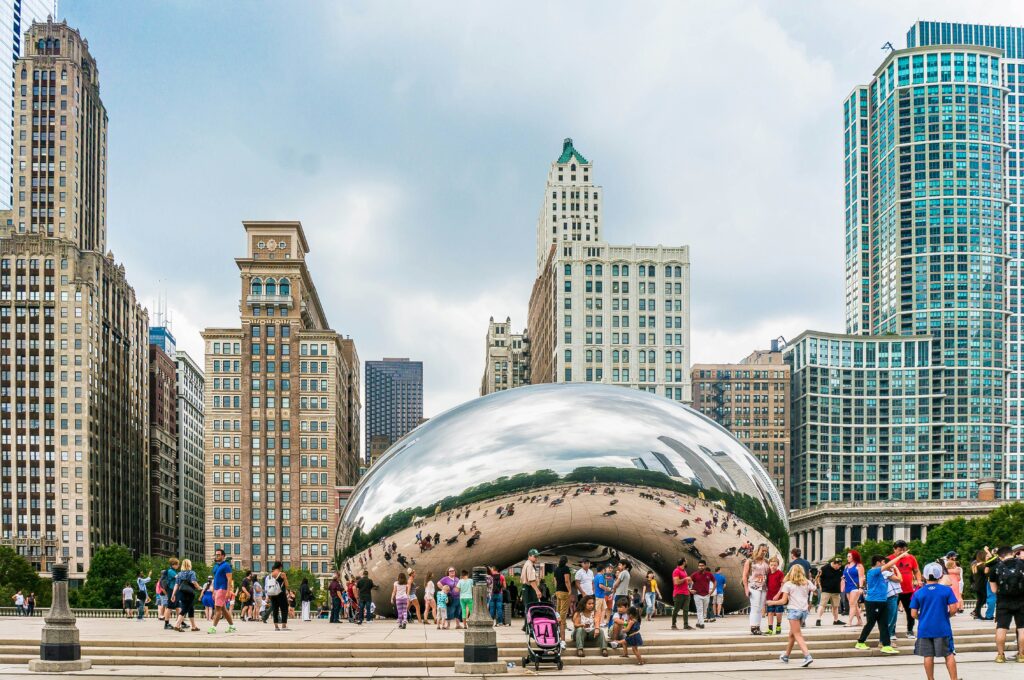
First-timers: September, or May for late spring, gives comfortable weather for the Loop, Riverwalk, and museums. Our 3 days in Chicago itinerary shows how to pace a first visit.
Families: Summer gives the best mix of beach and indoor time. Lifeguards are on duty 11 a.m. to 7 p.m. in season, and the Park District says to stay out of the water when the flag is red.
Smaller crowds: Lonely Planet points to winter, and to May and September through October as shoulder months. Choose Chicago links spring and fall with lighter crowds. Event weekends stay busy anywhere.
Cheapest Time to Visit Chicago
Winter is the best place to look for savings, but no month is guaranteed cheapest.
- Sources: Choose Chicago, the city’s tourism organization, says winter, especially January and February, typically brings the lowest hotel rates and flights. Lonely Planet agrees on winter hotel deals, says summer brings top rates, and sees deals in May and September through October.
- Gaps: No source we found publishes comparable monthly prices, so we don’t rank months or quote savings.
- Hotels, flights, and total cost differ. A cheap January room isn’t a bargain if the cold ruins your plans.
- Events: Lonely Planet notes big sporting events and festivals spike prices, and the marathon sells room blocks.
- Comparing fairly: Use the same nights, room type, cancellation terms, and fees across several date ranges.
Worst Time to Visit Chicago (and When to Think Twice)
No month is worst for everyone.
- Cold: January and February.
- Heat: July and August, with July the hottest.
- Swimming: Outside the beach season, swimming is prohibited when lifeguards are off duty.
- Disruption: Big event weekends, especially the marathon, whose closures can start days early.
- Holiday market: Arriving before it opens or after it closes.
Practical Planning Tips
- Pack for the whole day. May’s high and low are about 20°F (11°C) apart, so layer up.
- Respect winter wind, per the NWS wind chill guidance: hat, gloves, and a warm outer layer.
- Check events before booking a hotel. Closures can start early.
- Use transit on event days. The CTA lists St. Patrick’s reroutes, and the marathon advises public transit in the Loop.
Frequently Asked Questions
What is the best time to visit Chicago?
September for most first-time sightseeing trips, with May as the alternative. September’s 3.19 inches of precipitation is lower than May’s 4.49 (NWS). Choose June through August for swimming.
When is Chicago warmest?
July: high 84.5°F (29.2°C), low 66.4°F (19.1°C). August is close at 82.5°F (28.1°C) (NWS).
When is the cheapest time to visit Chicago?
Winter, especially January and February, according to Choose Chicago. Prices still depend on exact dates and events.
Is March a good time to visit Chicago?
It can be if you come for St. Patrick’s and accept the cold: 47.0°F (8.3°C) high, 31.0°F (−0.6°C) low, and 5.5 inches of snow (NWS).
Is April or October better?
October is warmer: 62.7°F (17.1°C) and 45.4°F (7.4°C), versus April’s 59.0°F (15.0°C) and 40.3°F (4.6°C) (NWS).
When can you enjoy Chicago’s lakefront?
Swimming runs from the Friday before Memorial Day through Labor Day, in designated areas with lifeguards on duty (Park District). Walking and sightseeing outside those dates depend on weather.
Final Recommendation
For the best time to visit Chicago on a first trip, choose September, or May for late spring. For beaches and warm evenings, choose June through August. For an indoor-led trip with a chance at lower prices, look at January and February. For a festival or the holiday market, pick the event and build around its confirmed dates. Before booking, check event dates, the forecast, and current hotel and flight prices for your exact dates.









[…] stay.Hotel prices also change with the season and local events. Our guide to the best time to visit Chicago can help you compare the city’s different travel […]
[…] For a day-by-day plan, read our guide to 3 Days in Chicago: A Practical Itinerary for First-Time Visitors. To choose your travel dates, see Best Time to Visit Chicago: A Month-by-Month Guide. […]
[…] For a more detailed month-by-month breakdown, see our guide to the best time to visit Chicago. […]