

Finding the best neighborhoods to stay in NYC depends on your budget, preferred atmosphere, subway access, and the attractions you plan to visit. Midtown is convenient for first-time visitors, while Hell’s Kitchen, Long Island City, and the Upper West Side offer different combinations of value, location, and atmosphere.
This guide compares 13 NYC neighborhoods to help you choose the right area for your budget and travel style. Hotel prices are planning estimates, not live rates, and can change depending on your travel dates and availability.
Best NYC Neighborhoods at a Glance
- For first-time visitors: Midtown offers convenient access to major attractions and subway connections.
- For better value near Broadway: Hell’s Kitchen combines restaurant options with a short walk to Times Square.
- For lower hotel costs: Long Island City in Queens is worth comparing with Manhattan, especially for longer stays.
- For families: The Upper West Side offers a more residential atmosphere near Central Park and the American Museum of Natural History.
- For couples: The West Village has charming streets, cafés, and restaurants, though hotels can be expensive.
- For skyline views: Brooklyn Heights and DUMBO offer waterfront scenery and access to Brooklyn Bridge Park.
The best choice depends on your budget, itinerary, and tolerance for subway travel. Compare the neighborhoods below before choosing a hotel.
| Neighborhood | Best for | Typical nightly range (estimate) | Vibe | Biggest drawback | Nearest transit hubs |
|---|---|---|---|---|---|
| Midtown | First-timers | $220–$450 | Busy, central | Crowds, noise | Times Sq–42 St, Grand Central, Penn Station |
| Hell’s Kitchen | Value near Broadway | $200–$380 | Casual, food-driven | Noisy blocks | 42 St–Port Authority, 50 St |
| Chelsea | Food, art, nightlife | $230–$420 | Trendy, artsy | Few cheap rooms | 23 St, 14 St |
| West Village | Couples | $300–$550 | Leafy, charming | Few hotels | W 4 St, Christopher St |
| SoHo | Shopping | $350–$600 | Stylish, crowded | Price | Spring St, Prince St |
| Upper West Side | Families | $200–$380 | Calm, residential | Quiet nights | 72 St, 81 St, Columbus Circle |
| Financial District | Downtown sights | $180–$350 | Quiet after dark | Sleepy evenings | Fulton St, WTC, Wall St |
| Brooklyn Heights & DUMBO | Skyline views | $220–$420 | Scenic, calm | Longer rides | Borough Hall, High St, York St |
| Long Island City | Value | $160–$300 | Modern, residential | Not Manhattan | Court Sq, Queensboro Plaza |
| Flatiron & NoMad | Boutique hotels | $250–$450 | Polished, central | Price | 23 St, 28 St |
| Upper East Side | Museums, quiet | $220–$420 | Refined, residential | Fewer subway lines | 86 St, 72 St |
| Williamsburg | Nightlife, food | $230–$450 | Trendy | Far from classic sights | Bedford Av |
| Lower East Side & East Village | Nightlife | $220–$400 | Loud, gritty | Late-night noise | Delancey–Essex, 2 Av, Astor Pl |
How Transit Access Affects Your Neighborhood Choice
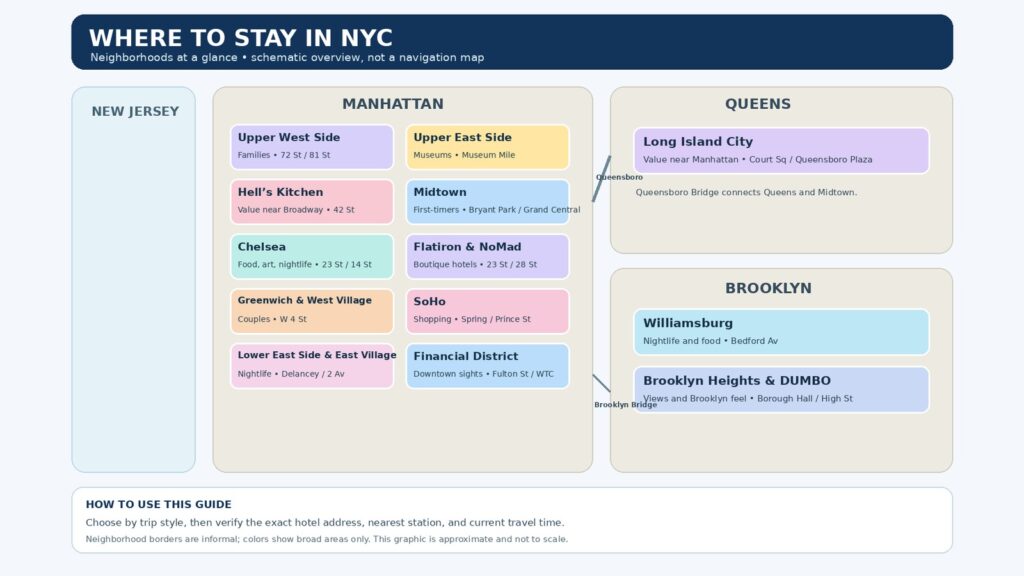
New York City’s subway connects Manhattan with Brooklyn and Queens, so staying outside Manhattan can be practical if your hotel is near a convenient station. However, the nearest station, available train lines, transfers, and your planned destinations matter more than the neighborhood name alone.
Before booking, check the walking distance from the hotel to the station and the route to your main attractions. For airport-specific routes, fares, and service updates, use the official MTA airport transportation guide.
For a broader accommodation decision guide, see our Where to Stay in New York City.
Best Neighborhoods to Stay in NYC
Tier 1: Core Picks
Midtown: Best for First-Time Visitors
Best for: First trips and short stays.
The vibe: Busy and bright.
Why stay here: Most big sights are walkable or one stop away. The Bryant Park and Grand Central side is calmer, with easier connections.
Getting around: The most subway lines in the city meet here.
Hotels and price: Big chains and business hotels, estimated $220–$450.
Pros: Central, huge choice, easy airport links.
Cons: Crowds, noise, small rooms, average food near Times Square.
Skip it if: You want a neighborhood feel.
Hell’s Kitchen: Best for Value Near Times Square
Best for: Broadway on a budget.
The vibe: Casual and food-focused.
Why stay here: Ninth Avenue is packed with restaurants. Times Square is a short walk.
Getting around: A/C/E at 42 St–Port Authority, C/E and 1 at 50 St.
Hotels and price: Mid-range chains and newer boutiques, estimated $200–$380.
Pros: Better dining, often cheaper than Times Square.
Cons: Far-west blocks mean a long walk to the subway. Some noise near bars and Port Authority.
Skip it if: You want to be a block from the Square.
Chelsea: Best for Food, Art, and Nightlife
Best for: Food lovers and gallery fans.
The vibe: Trendy and artsy.
Why stay here: The High Line, Chelsea Market, and the gallery blocks are close. Nightlife is strong.
Getting around: 1, C/E, F/M near 23 St, and the A/C/E and L at 14 St. Times Square is a short subway ride.
Hotels and price: Boutique and mid-range, estimated $230–$420.
Pros: Great food, easy High Line walks.
Cons: Few cheap rooms. Some blocks are far from the subway.
Skip it if: Broadway is your main goal.
Greenwich Village & West Village: Best for Couples
Best for: Romantic weekends.
The vibe: Leafy streets, townhouses, cozy cafes.
Why stay here: It’s very walkable. Dinner options are excellent, and the neighborhood feels local.
Getting around: W 4 St (A/C/E, B/D/F/M) and Christopher St (1).
Hotels and price: A handful of small boutiques, estimated $300–$550.
Pros: Charm, restaurants.
Cons: Very limited inventory and high prices.
Skip it if: You’re on a budget or want big sights next door.
SoHo: Best for Shopping and Style
Best for: Shoppers and design fans.
The vibe: Cast-iron buildings, cobblestones, boutiques.
Why stay here: The streets are fun to wander. Restaurants are plentiful. You’re a short walk from Greenwich Village and Chinatown.
Getting around: Spring St (C/E, 6), Prince St (R/W), Broadway–Lafayette (B/D/F/M).
Hotels and price: Boutique and luxury, estimated $350–$600.
Pros: Stylish, walkable, strong dining.
Cons: Pricey and packed on weekends.
Skip it if: You want value or quiet.
Upper West Side: Best for Families
Best for: Families with kids.
The vibe: Residential and relaxed.
Why stay here: Central Park, the American Museum of Natural History, and Riverside Park are close.
Getting around: The 1/2/3 run along Broadway. The B/C run along Central Park West. Times Square is a short ride on an express.
Hotels and price: Older mid-range hotels and suites, estimated $200–$380.
Pros: Calm, roomier, good for kids.
Cons: Quiet nights. Longer trips downtown.
Skip it if: You want nightlife.
Financial District: Best for Downtown Sightseeing
Best for: Lower Manhattan sights.
The vibe: Office towers by day, quiet at night and on weekends.
Why stay here: The 9/11 Memorial & Museum and One World Trade Center are close. Ferries to the Statue of Liberty leave from nearby Battery Park. The National Park Service says Statue City Cruises is the only authorized ticket seller.
Getting around: Many lines at Fulton St, WTC, and Wall St. Times Square is a longer subway ride.
Hotels and price: Converted office buildings and modern towers, estimated $180–$350.
Pros: Often good value (check your dates), easy ferry access.
Cons: Few late-night options.
Skip it if: Broadway or nightlife matters.
Brooklyn Heights & DUMBO: Best for Views and a Brooklyn Feel
Best for: Skyline views, bridge walks.
The vibe: Calm, scenic, waterfront.
Why stay here: The Brooklyn Heights Promenade, Brooklyn Bridge Park, and the Brooklyn Bridge are right there.
Getting around: Borough Hall and Clark St (2/3/4/5), High St (A/C), York St (F). Midtown is a longer ride, often with a transfer.
Hotels and price: Boutique and waterfront hotels, estimated $220–$420. DUMBO costs more.
Pros: Views, calm streets.
Cons: Fewer hotels and longer commutes.
Skip it if: You have only two or three days.
Long Island City: Best for Value Near Manhattan
Best for: Savings with a quick ride in.
The vibe: Modern towers, waterfront parks.
Why stay here: Gantry Plaza State Park has a skyline view, and newer hotels often cost less than Midtown.
Getting around: Court Sq (E/M/G/7) and Queensboro Plaza (N/W/7). The 7 train reaches Grand Central in a short ride.
Hotels and price: Newer chains, estimated $160–$300.
Pros: Lower rates, fast subway.
Cons: It’s Queens, not Manhattan. Fewer restaurants and sights nearby.
Skip it if: You want to walk home from Broadway.
Tier 2: Also Consider
Flatiron & NoMad: Best for Boutique Hotels in a Central Spot. Madison Square Park and the Empire State Building are close, with subway hubs at 23 St and 28 St. Hotels are stylish but pricey for the room size.
Upper East Side: Best for Museums and a Quieter Stay. The Met and Museum Mile are the draw. Subway options are thinner than on the west side.
Williamsburg: Best for Nightlife and Food. Most first-time sights are in Manhattan, and the L train is your main link. It suits a second trip better.
Lower East Side & East Village: Best for Nightlife and Edgier Food. Bars, music, and great cheap eats. Expect late-night noise, a few hotels, and some walks to the subway.
Is Times Square the Best Place to Stay in NYC?
Not always. It’s very convenient for a short Broadway trip, but it’s the busiest, loudest part of the city.
Reasons to stay: Theaters at your door, big subway hub, late-night ease.
Reasons to choose elsewhere: Crowds, noise, small rooms, so-so food.
- Times Square: Maximum sightseeing and Broadway convenience, but the busiest.
- Bryant Park / Midtown East: A more balanced first-time base, still central.
- Hell’s Kitchen: A nearby alternative with better restaurants and often better prices.
Manhattan vs. Brooklyn (and Queens): Where Should You Stay?
| Area | Commute to major sights | Hotel selection | Price | Vibe | Best for |
|---|---|---|---|---|---|
| Manhattan | Walk or 1 to 2 stops | Huge | Higher | Busy, classic | Short trips |
| Brooklyn | Longer ride to Midtown | Medium | Mixed | Local, scenic | Views, return visitors |
| Queens (LIC) | Short ride to Midtown | Smaller | Lower | Modern | Savings |
For most first-time visitors, Manhattan is the easier choice on a short trip. More sights and hotels sit within a short walk or ride. Brooklyn or Queens can be smarter if you’re staying five nights or more, the savings top $100 a night, or you’re comfortable with the subway. For a broader overview, see our guide to where to stay in New York City.
How to Choose the Best Neighborhood for Your Trip
Your ideal NYC neighborhood depends on how much time you have, your budget, and how often you’re willing to use the subway.
Consider How Long You’re Staying
- 2–3 days: Midtown or Hell’s Kitchen can reduce travel time to many major attractions.
- 4–5 days: Consider Chelsea, the Upper West Side, or the Financial District based on your itinerary and preferred atmosphere.
- 6+ days: Compare Long Island City and Brooklyn with Manhattan. A hotel farther from the main attractions may offer savings, but check subway access and commuting time before booking.
Your itinerary matters as much as the number of days. Use our guide to how many days you need in New York City to plan your visit.
Best Neighborhoods by Traveler Type
| Traveler | Top pick | Runner-up | Why |
|---|---|---|---|
| First-timers | Midtown | Hell’s Kitchen | Central and easy |
| Families | Upper West Side | Midtown | Park and museum |
| Couples | West Village | Chelsea | Walkable, romantic |
| Nightlife | Chelsea | Lower East Side | Bars and late dining |
| Sightseeing | Midtown | Financial District | Closest to landmarks |
| Budget | Long Island City | Hell’s Kitchen | Lower rates |
Balance Hotel Price With Convenience
Look at total trip cost: room, taxes, subway rides, and time. Say a $100 saving adds 50 minutes of daily travel. Over a few days, that costs you hours. Prices also swing with holidays and big events, so compare nearby dates. Our guide to the best time to visit New York City can help you choose.
Are NYC Neighborhoods Safe for Tourists?
Most visitors have a trouble-free trip, but no area is risk-free, and conditions vary by block and time. The NYPD posts citywide crime statistics weekly. Its figures through July 2026, as reported by ABC7, showed record-low shootings and murders, though transit crime was up about 1% for the year. City totals can’t describe a single block.
How to Think About Safety When Choosing a Neighborhood
Pickpockets work crowds, so keep your phone and bag close. Late at night, use busy stations or a ride-hail.
Should You Avoid Certain Areas?
No. I won’t give you a “dangerous” list. Check your hotel’s exact address on a map and read recent guest reviews. The NYPD’s precinct statistics add context, but they don’t score a block.
Tips for Booking a Hotel in NYC
Check the exact location and subway distance. A neighborhood name alone isn’t enough. Check the hotel’s walking distance to the nearest subway station and the routes to the attractions you plan to visit.
Compare the total cost before booking. The displayed room rate may exclude taxes and other charges. New York City and New York State impose hotel-related taxes and fees, and some properties may charge additional disclosed fees. Review the final booking total, including taxes and any extra charges, before paying.
Read recent hotel reviews. Look for comments about cleanliness, street noise, room size, elevators, construction, and whether the hotel’s location matches its description.
Consider noise and room size. NYC hotel rooms can be compact, especially in busy areas. If quiet matters to you, check recent reviews and request a room away from busy streets when possible.
For more accommodation advice, including how to choose the right area and avoid common booking mistakes, read our Where to Stay in New York City guide.
Frequently Asked Questions About Where to Stay in NYC
Where should I stay in NYC for a weekend? Midtown or Hell’s Kitchen.
Which area is easiest to reach from JFK, LaGuardia, and Newark? It depends on your route and luggage. Hotels near Penn Station or Grand Central suit rail connections best, including LIRR from JFK and NJ Transit from Newark. LaGuardia has no train, so plan on the subway plus the free Q70 bus, the M60 from uptown, or a taxi. The MTA’s airport guide warns of crowded vehicles and stairs, so with heavy bags, kids, or a late arrival, a taxi or car may be easier. Taxi times vary with traffic. NYC Tourism lists 40 to 60 minutes from JFK, and longer at busy times.
How many days do I need for a first trip? Four to five full days suits most first-timers. Three can work with a tighter plan, as our days-in-NYC guide explains.
Is it cheaper to stay outside Manhattan or in New Jersey? Sometimes. New Jersey adds a train or bus ride each way, so LIC or Brooklyn is usually easier.
When are NYC hotel prices highest? When demand peaks, such as holidays and big event weeks. Compare nearby dates.
Is Brooklyn a good choice for first-time visitors? Yes, if you pick Brooklyn Heights or DUMBO and accept a longer ride to Midtown.
Final Recommendation: Where Should You Stay in NYC?
- Unsure? Midtown, near Bryant Park or Grand Central
- Broadway on a budget? Hell’s Kitchen
- Romantic trip? West Village
- Food and nightlife? Chelsea
- Families? Upper West Side
- Shopping? SoHo
- Downtown sightseeing? Financial District
- Brooklyn feel? Brooklyn Heights or DUMBO
- Value near Manhattan? Long Island City
If you can’t decide, book Midtown and stop worrying. Then see our best things to do in New York City for first-time visitors.









[…] Best Neighborhoods to Stay in NYC: A First-Time Visitor’s Guide […]